

NEW UPDATES FOR MICRO-CAPTIVES
Article summary
- Final IRS regulations issued (Regs. Sec. 1.6011-10 and 1.6011-11): On January 10, 2025, the U.S. Treasury and IRS finalized rules defining when a micro-captive insurance company is treated as participating in a listed transaction or transaction of interest, and clarified related reporting obligations for the captive, insured entities, owners, and advisors.
- Reporting requirements expanded: The regulations explain who must file disclosures (e.g., micro-captive, insured entities, owners, and material advisors) and generally require Form 8886 to be filed when a transaction is identified as reportable under the new rules.
- Links to related guidance and context: The post connects to a series of deeper articles on the history of micro-captive regulation, how to determine listed vs. interest transactions, reporting specifics, revoking Section 831(b) elections, and successor captive issues.
- Practical engagement: The firm suggests contacting its captive team for tailored advice, reflecting that implementation and compliance can vary based on each captive’s circumstances
Final regulations announced
On January 10, 2025, the Department of the Treasury (“Treasury”) and the Internal Revenue Service (“IRS”) issued final regulations (Regs. Secs. 1.6011-10 and 1.6011-11) related to micro-captive insurance companies. The final regulations outline when a micro-captive insurance company is deemed to be participating in a listed transaction or a transaction of interest and provides guidance on filing obligations for micro-captive insurance companies and related parties, including insured entities, owners, and material advisors.
These articles go through the essential information contained in the Final Regulations issued on January 10, 2025, by the Department of the Treasury and the Internal Revenue Service (Regs. Secs. 1.6011-10 and 1.6011-11) related to micro-captive insurance companies.
How Did We Get Here? The History of Notice 2016-66 and the Micro-Captive Regulations
For many years, the use of micro-captive insurance companies has been under scrutiny by the Internal Revenue Service (“IRS”). In November 2016, the IRS issued Notice 2016-66, which was designed to help the IRS gather data on micro-captive insurance arrangements. That notice, modified by Notice 2017-08, designated certain micro-captive transactions as "transactions of interest," a category used by the IRS to flag transactions that have the potential for tax abuse but have not been fully designated as abusive tax shelters.
The notice faced significant legal challenges from taxpayers and industry professionals, many of whom argued that the notice was overly broad and burdensome. One of the primary objections was the imposition of disclosure requirements on transactions that had not been officially deemed abusive. Litigation ensued, including the notable case of CIC Services, LLC v. IRS, which reached the Supreme Court in 2021.
CIC Services, LLC held that Notice 2016-66 was issued illegally because the IRS did not follow the law prescribed under the Administrative Procedures Act. However, the IRS argued that the Anti-Injunction Act, which prohibits federal courts from issuing injunctions that “restrain” the “collection or assessment of a tax,” prevented federal courts from stopping the enforcement of Notice 2016-66 by the IRS. The Supreme Court ruled in favor of the taxpayer since the law in question imposed burdens on taxpayers (including the possibility of criminal penalties) when the collection of some unknown amount of tax from unidentified taxpayers was many steps down the line.
Following that loss the Treasury Department and the IRS issued proposed regulations addressing micro-captive transactions in a Notice of Proposed Rulemaking (“NPRM”). The NPRM made Notice 2016-66 obsolete and provided for the appropriate and necessary steps of soliciting public comment. The period for public comment closed on June 12, 2023, and taxpayers in the captive industry have since been waiting for the final regulations.
The wait ended at the beginning of 2025. The Treasury Department and the IRS considered input from over 100 stakeholders and incorporated some changes that aim to address industry concerns. We will discuss in the remaining articles the impact of the final regulations and how the revisions to the proposed regulations narrow the scope of the reporting requirements for participants of micro-captive transactions.
What Is a Listed Transaction, What Is a Transaction of Interest, and Why Does It Matter?
In Regs. Sec. 1.6011-4, the Internal Revenue Service (“IRS”) outlines the identification and handling of potentially abusive transactions, which are called “reportable transactions.” When a taxpayer participates in a reportable transaction, they are required to disclose additional information on their tax return by attaching Form 8886, Reportable Transaction Disclosure Statement.
There are currently five kinds of reportable transactions:
- Listed transactions
- Confidential transactions
- Transactions with contractual protection
- Loss transactions
- Transactions of interest
The final micro-captive regulations issued on January 10, 2025, identify certain transactions involving micro-captive insurance companies as listed transactions and others as transactions of interest. To understand the full impact of the final regulations on micro-captive insurance companies, it is important to understand how the IRS views listed transactions and transactions of interest.
Listed Transaction
In Regs. Sec. 1.6011-4(b)(2), the IRS indicates that listed transactions are those that they have “determined to be a tax avoidance transaction.” In other words, the IRS treats those participating in a listed transaction as guilty of tax avoidance unless proven innocent. Listed transactions are the most serious and scrutinized of all the reportable transactions. The addition of certain micro-captive transactions as listed transactions marks only the third time since 2008 that the IRS has identified a new listed transaction. There is a presumption that the IRS will examine each micro-captive insurance company deemed to be participating in a listed transaction.
Transaction of Interest
Transactions of interest are those “that the IRS and the Treasury Department believe to have the potential for tax avoidance or evasion but lack sufficient information” to determine whether that is the case. In other words, these are transactions the IRS is interested in (hence the name) and would like to keep track of. But unlike listed transactions, there is no presumption of tax avoidance. Prior to the final micro-captive regulations and under the old guidance of Notice 2016-66, the only reportable transaction designation possible for micro-captive transactions was a transaction of interest.
The addition of a micro-captive listed transaction in the final regulations will allow the IRS to focus their efforts on those micro-captive insurance companies more likely to be participating in tax avoidance.
When Is a Micro-Captive Insurance Company Deemed to Be Participating in a Listed Transaction?
Regs. Sec. 1.6011-10 of the final micro-captive regulations outlines the elements that need to be present for a micro-captive transaction to be considered a listed transaction in the eyes of the IRS. This includes all the following:
- The micro-captive has made the 831(b) election and the election has not been revoked.
- At least 20% of the micro-captive’s assets or the voting power or value of its stock is owned, directly or indirectly, by (a) an insured entity, (b) an owner of an insured entity, or (c) a party related to (a) or (b).
- The micro-captive must have been in existence for at least ten tax years.
- During the last ten tax years, the micro-captive’s loss ratio must be below 30%.
-
A micro-captive’s loss ratio is computed as follows:
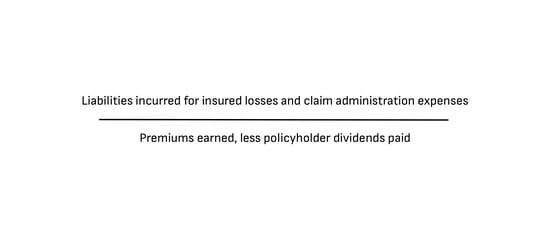
5. One of the following elements is present:
- During the last five tax years, the micro-captive made financing available to (a) an insured entity, (b) an owner of an insured entity, or (c) a party related to (a) or (b) in a transaction that did not result in taxable income to the recipient of the funds, such as a loan or guarantee.
- Prior to the last five tax years, the micro-captive made financing available to (a) an insured entity, (b) an owner of an insured entity, or (c) a party related to (a) or (b) in a transaction that did not result in taxable income to the recipient of the funds, such as a loan or guarantee, and the financing provided has not been returned to the captive as of the end of the preceding tax year.
If the above elements are present, the IRS will consider the micro-captive transaction to be a listed transaction, and the participants to the transaction will be required to comply with additional reporting and disclosure requirements.
When Is a Micro-Captive Insurance Company Deemed to Be Participating in a Transaction of Interest?
Regs. Sec. 1.6011-11 of the final micro-captive regulations outlines the elements that need to be present for a micro-captive transaction to be considered a transaction of interest in the eyes of the IRS. This includes all the following:
- The micro-captive has made the 831(b) election and the election has not been revoked.
- At least 20% of the micro-captive’s assets or the voting power or value of its stock is owned, directly or indirectly, by (a) an insured entity, (b) an owner of an insured entity, or (c) a party related to (a) or (b).
- One of the following elements is present:
- Loss Ratio Threshold Not Met
The micro-captive’s loss ratio is less than 60% during whichever of the following periods is applicable: (1) the last ten taxable years, or (2) all taxable years of the micro-captive, if the micro-captive has been in existence for less than ten taxable years.
A micro-captive’s loss ratio is computed as follows: 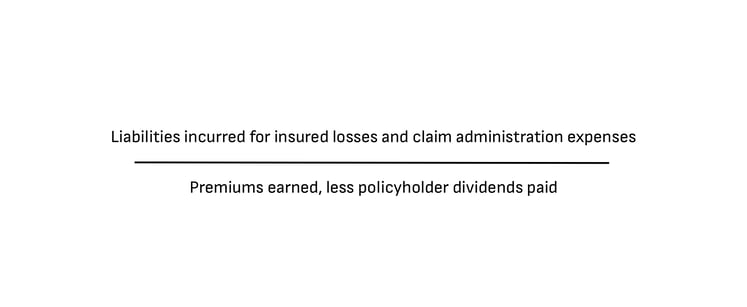
- Existence of Related Party Financing
During the last five tax years, the micro-captive made financing available to (1) an insured entity, (2) an owner of an insured entity, or to (3) a party related to (1) or (2) in a transaction that did not result in taxable income to the recipient of the funds, such as a loan or guarantee, or
Prior to the last five tax years, the micro-captive made financing available to (a) an insured entity, (b) an owner of an insured entity, or (c) a party related to (a) or (b) in a transaction that did not result in taxable income to the recipient of the funds, such as a loan or guarantee, and the financing provided has not been returned to the captive as of the end of the preceding tax year.
If the above elements are present, the IRS will consider the micro-captive transaction to be a transaction of interest, and the participants to the transaction will be required to comply with additional reporting and disclosure requirements.
Flowchart: Determining Whether a Micro-Captive Transaction is a Listed Transaction or a Transaction of Interest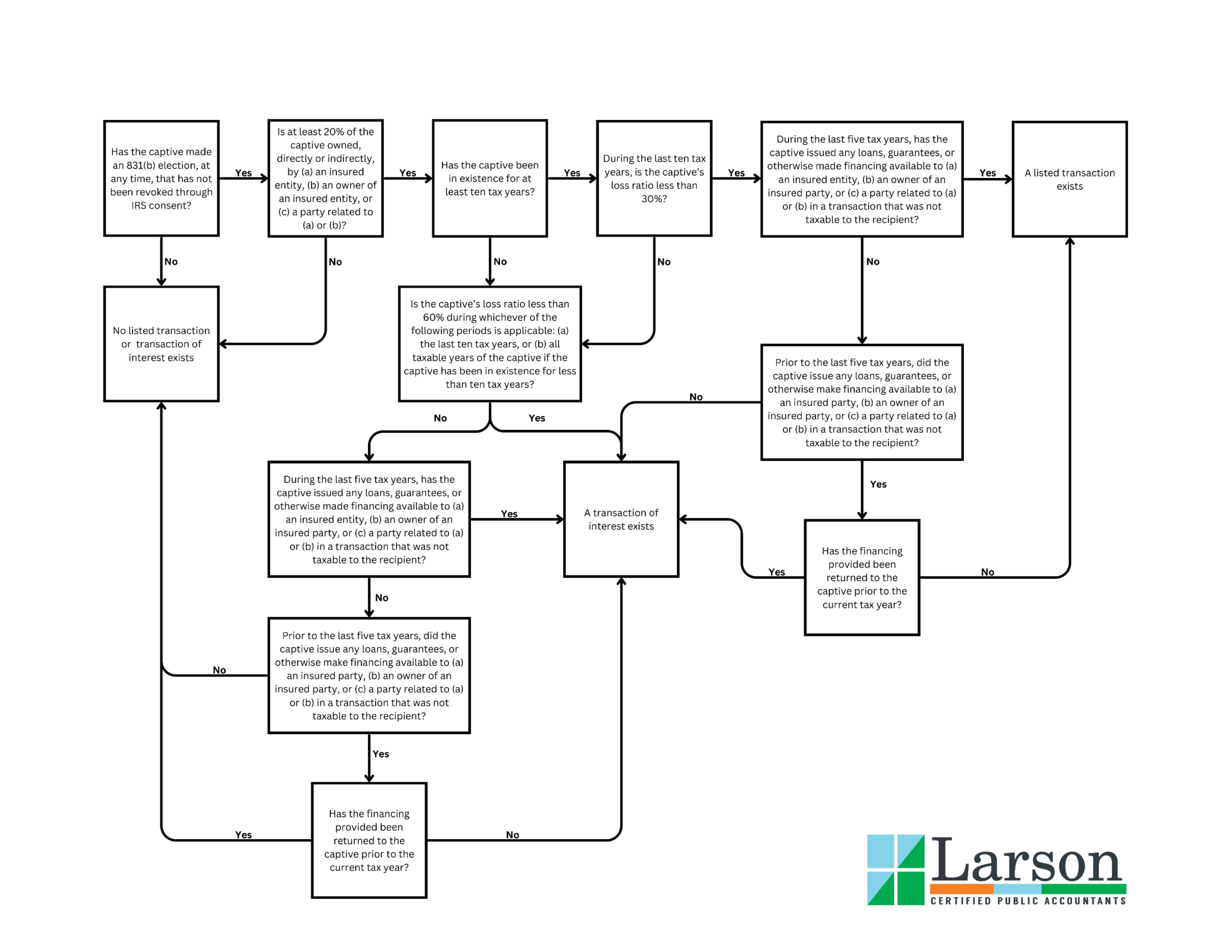
Download a pdf copy of this image.
What Are the Reporting Requirements for a Micro-Captive Insurance Company That Is Deemed to Be Participating in a Listed Transaction or a Transaction of Interest?
Who Does the IRS Consider a “Participant” in a Micro-Captive Transaction?
The IRS considers the parties listed below to be Participants in a micro-captive transaction if the tax returns of the parties reflect a tax consequence or a tax strategy resulting from the micro-captive transaction.
- The micro-captive insurance company
- Entities insured by the micro-captive insurance company (“Insured Entities”)
- Owners of entities insured by the micro-captive insurance company
- Any entity that issues an insurance contract to an Insured Entity and such contract is reinsured by the micro-captive insurance company
- Any entity that reinsures an insurance contract to an Insured Entity and such contract is reinsured by the micro-captive insurance company
While these are the parties specifically listed as Participants in the final regulations, the final regulations also make clear that Participants are not limited to only these parties. Other parties could be considered Participants subject to IRS discretion.
General Reporting Requirement
All Participants must prepare and include a copy of Form 8886, Reportable Transaction Disclosure Statement (“Form 8886”), with their tax return for each taxable year in which they participate in the micro-captive transaction.
Reporting Exception for Owners of Insured Entities (“Owners”)
There is an exception from reporting for Owners if the following requirements are met:
- The Owner is participating in the micro-captive transaction solely due to their direct or indirect ownership in an insured entity, and
- The Owner receives written or electronic acknowledgment from the insured entity that it has, or will, comply with its separate disclosure obligations.
Note that the acknowledgment received by the Owner can be a copy of the Form 8886 that the Insured Entity(ies) files with the IRS.
Owners who meet this safe harbor provision will not be treated as having participated in an undisclosed listed transaction or transaction of interest, or as failing to include necessary information on any return or statement related to the listed transaction or transaction of interest.
Reporting Exception for Participants in Transactions with Revoked 831(b) Elections
Another exception applies to Participants involved in a micro-captive transaction with a revoked 831(b) election. If the micro-captive has revoked its 831(b) election, Participants in the transaction are no longer considered Participants and are exempt from the disclosure requirements. As with the reporting exception for owners of insured entities, these Participants will not be treated as having participated in an undisclosed listed transaction or transaction of interest or as failing to disclose any required information on any return or statement.
Listed Transactions – Reporting Requirements for Open Tax Years
Effective January 14, 2025, the final regulations impose additional reporting requirements for Participants with respect to prior tax years. Participants must disclose the transaction for open tax years that are within the “period of limitations for assessment of tax” under Section 6051. The period of limitations will vary depending on specific circumstances, but for most taxpayers it will encompass the previous three tax years. In addition to filing Form 8886 with the IRS for those prior tax years, Participants are also required to provide a copy of the initial Form 8886 to the Office of Tax Shelter Analysis (“OTSA”) within 90 days of the January 14, 2025 effective date.
Participants who have finalized a settlement agreement with the IRS regarding their participation in a micro-captive listed transaction will be treated as having made the necessary disclosures for the years covered by the examination agreement.
Transactions of Interest – Reporting Requirements for Open Tax Years
The reporting obligations for a transaction of interest, with respect to prior periods, are similar to those for listed transactions. However, there is an important exception that relieves Participants from having to file Form 8886 for open tax years. Under Regs. Sec. 1.6011-11(h)(2), Participants who have filed Form 8886 with the OTSA pursuant to Notice 2016-66 will be treated as having made the necessary disclosures under the final regulations for all tax returns filed before January 14, 2025. However, for the first tax year after the effective date of the regulations, the Participant will be required to file a new initial Form 8886 with the OTSA.
What Information Is Required to Be Reported on Form 8886, Reportable Transaction Disclosure Statement, with Respect to Micro-Captive Listed Transactions and Transactions of Interest?
Regs. Sec. 1.6011-10 and 1.6011-11 specify the information that participants must report on Form 8886, Reportable Transaction Disclosure Statement, if they are involved in a Listed Transaction or a Transaction of Interest. While the reporting requirements are consistent across both types of reportable transactions, the information required under these new regulations differs significantly from the requirements outlined in Notice 2016-66, which was in effect prior to their implementation. Below is a side-by-side comparison of the various information requirements that participants must include in their disclosures. For more information contact our Larson captive team to find out how this will affect your micro-captive..jpg?width=2550&height=3300&name=What%20informations%20is%20required%20to%20be%20reported%20on%20form%208886%2c%20table%20(4).jpg)
How Can a Micro-Captive Revoke Its Section 831(b) Election?
One potential response to the final micro-captive regulations and the possible requirement to report a listed transaction is to revoke a micro-captive’s section 831(b) election. By doing so, micro-captive insurance companies would no longer be required to file Form 8886 with the Internal Revenue Service (“IRS”) disclosing their participation in a listed transaction.
Historically, once a section 831(b) election was made, it could only be revoked with the consent of the IRS. Obtaining this consent required requesting a private letter ruling (“PLR”), a process that is both time-consuming and costly. For instance, certain PLR requests made after February 1, 2025 – including those for revoking a section 831(b) election – carry a user fee of $43,700, payable to the IRS.
Fortunately, alongside the release of the final micro-captive regulations, the IRS issued Rev. Proc. 2025-13, which introduces a streamlined procedure for taxpayers to revoke their section 831(b) election. This procedure involves submitting a written request to the IRS, either by mail or fax, an example of which is provided in Section 5 of Rev. Proc. 2025-13.
Notable aspects of the streamlined procedures include the following:
- There is no user fee associated with the revocation under Rev. Proc. 2025-13.
- The revocation can take effect in either (1) the year the revocation request is submitted or (2) the first preceding taxable year, provided the request is filed no later than the due date (including extensions) of the micro-captive’s federal income tax return. For a calendar-year taxpayer, this means the revocation can be effective for the 2024 tax year if the request is submitted by October 15, 2025.
- A micro-captive that revokes its section 831(b) election must include a representation in the revocation request stating that it will not make a section 831(b) election for the five taxable years following the year of revocation.
- To qualify for the streamlined procedures, a micro-captive must not have net operating losses from a prior section 831(b) tax year that could be carried over and utilized in the year of revocation.
Rev. Proc. 2025-13 and the new streamlined procedures bring welcome news to owners of micro-captive insurance companies seeking to avoid IRS scrutiny and potential examinations, particularly given the risk of their micro-captive transaction being designated as a listed transaction.
What Is a “Successor Captive” and What Do the Final Regulations Say About Them?
For a micro-captive transaction to be considered a listed transaction, the micro-captive insurance company participating in the transaction must have been in existence for ten tax years, among other requirements (see this post for a complete list of what must be present to be considered a listed transaction).
To avoid a listed transaction designation, possible solutions that have been suggested for micro-captive insurance companies that have existed for ten years, or are nearing that point, are to (1) form a new micro-captive insurance company (the “New Captive”) to take the place of the previous micro-captive insurance company (the “Predecessor Captive”), or (2) participate in a reorganization in which Predecessor Captive goes out of existence and another entity, whether new or old (the “Surviving Captive”), inherits the business of Predecessor Captive. The goal of these possible solutions is to restart the clock and remove the ten-year taint that could lead to a designation as a listed transaction.
However, the final regulations contain rules regarding “successors” and in certain circumstances, a New Captive or Surviving Captive could be considered a successor to the Predecessor Captive. The result of that designation is that the taxable years of the Predecessor Captive would be attributable to the New or Surviving Captive, which could lead to a listed transaction designation.
The tax years of a Predecessor Captive can be attributed to a New Captive or Surviving Captive in the following scenarios:
- If the Predecessor Captive distributes its assets and liquidates into a parent corporation (the Surviving Captive) under Section 332.
- If the Predecessor Captive is a party to one of the reorganizations below, which are described in Section 368(a)(1), in which the Predecessor Captive goes out of existence and a new entity (New Captive or Surviving Captive) continues:
- Section 368(a)(1)(A): Statutory merger or consolidation
- Section 368(a)(1)(C): Asset acquisition
- Section 368(a)(1)(D): Transfer to a controlled corporation
- Section 368(a)(1)(F): Identity change
- Section 368(a)(1)(G): Bankruptcy reorganization
- Any other transaction in which an entity, directly or indirectly, acquires (or is deemed to acquire) the assets of a Predecessor Captive and succeeds to and takes into account the Predecessor Captive’s earnings and profits.
- Any other transaction in which an entity receives (or is deemed to receive) any assets from a Predecessor Captive if such entity’s basis in such assets is determined, directly or indirectly, in whole or in part, by reference to the Predecessor Captive’s basis in such assets.
The transactions and reorganizations described above can, if certain requirements are met, be tax-free transactions or reorganizations. In instituting the successor corporation rules in the final regulations, the IRS is not allowing micro-captive insurance companies to avoid the ten-year taint by taking part in a tax-free reorganization.
In order for a New Captive or Surviving Captive to be free from inheriting the tax years of a Predecessor Captive, the newly formed micro-captive insurance company must be capitalized with assets completely independent of the Predecessor Captive and ensure that all other applicable rules are met.
Federal Court Invalidates IRS Loss-Ratio Standard for Micro-Captive Reportable Transactions
A recent federal district court decision has delivered a significant blow to the IRS’s regulatory approach toward micro-captive insurance companies. In Ryan LLC v. Internal Revenue Service, the court held that the IRS’s use of the 30% and 60% loss-ratio thresholds—used to classify micro-captive arrangements as either listed transactions or transactions of interest—was arbitrary and capricious, violating the Administrative Procedure Act (APA).
This ruling could have far-reaching effects, calling into question the final micro-captive regulations (T.D. 10029) issued in January 2025 and their overall applicability and enforceability.
Background: The IRS’s 30% / 60% Loss-Ratio Framework
The final micro-captive regulations issued in January 2025 set forth the criteria for when a micro-captive transaction is considered a transaction of interest and when it is classified as a listed transaction. Both classifications are primarily based on the loss ratio, with additional requirements needed to meet listed transaction status:
- Transaction of Interest: The micro-captive has a loss ratio below 60%.
- Listed Transaction: The micro-captive has a loss ratio below 30%, has been in existence for at least 10 years, and has issued financing to a related party.
Court Ruling on Loss Ratios: Arbitrary and Capricious
In Ryan, LLC v. Internal Revenue Service, Ryan, LLC claims that the IRS’s loss ratio thresholds are arbitrary and capricious because Treasury provided no explanation for why the loss ratios chosen would effectively distinguish abusive transactions from permissible ones.
The 60% Threshold for Transactions of Interest
The 60% threshold is based on property and casualty loss ratios for commercial insurers as reported in the Annual NAIC Report on Profitability by Line by State for each year from 2013 through 2022. After excluding certain business lines that micro-captive insurance companies typically do not or cannot cover, Treasury ended up with an “average modified loss ratio factor of 67%.”
Based on this data, the original proposed regulations in 2024 set the loss ratio threshold at 65%. The IRS later lowered it to 60% after commenters argued the ratio remained too high. The key issues raised by commenters were:
- Micro-captive insurance companies typically pay out only for major, infrequent events, resulting in lower loss ratios compared to commercial insurers.
- The data set to determine the 60% ratio primarily consisted of commercial insurers, which have different loss profiles than micro-captive insurance companies, making the comparison unreliable.
Despite acknowledging these issues, Treasury failed to explain why the final 60% loss ratio would be an appropriate measure for identifying abusive micro-captive arrangements. Treasury simply noted that commenters had not “identified any alternative published data set” and that it was not “aware of one” that could provide a more accurate ratio. Effectively, the Treasury relied on an apples-to-oranges comparison because no better data existed.
As a result, Ryan, LLC argued that Treasury did not provide a “satisfactory explanation for its actions,” rendering the 60% loss ratio arbitrary and capricious.
The 30% Threshold for Listed Transactions
Treasury settled on a 30% loss ratio after considering the Tax Court case R.V.I. Guar. Co., Ltd. & Subs. v. C.I.R., 145 T.C. 209 (2015), 90 Fed. Reg. at 3541. In that case, the insurance company’s loss ratio fluctuated dramatically, from a low of 0.2% to a high of 97.9%, with a ten-year average of 32%. Based on this data, Treasury concluded that a 30% loss ratio was a reasonable ratio.
Ryan, LLC challenged this approach, arguing that relying on a single case to justify the 30% loss ratio was insufficient, as one insurance company does not provide a large enough data set from which to draw reliable conclusions. Ryan, LLC further noted that the Tax Court found that the insurance company was not engaged in a tax avoidance scheme, yet its loss ratio history showed the following:
- In nine of the fourteen years in question, the loss ratio was below 30%.
- If not for one year when the loss ratio spiked to 97%, the company’s average loss ratio would have been well below 30%.
- In four of the fourteen years, the loss ratio was at or below 1%.
Ryan, LLC contended that this data demonstrates that even a legitimate insurance company can have a loss ratio below Treasury’s 30% threshold in most years. Therefore, Ryan, LLC alleged that Treasury failed to draw a “rational connection between the facts found and the choice made” in selecting the 30% loss ratio, rendering it arbitrary and capricious.
Conclusion
The Tax Court’s decision does not automatically invalidate the micro-captive regulations, but it does open the door for additional challenges to the loss-ratio metric as a valid measure for identifying abusive micro-captive transactions. If other courts reach similar conclusions, the IRS could be compelled to withdraw or substantially revise the regulations, potentially replacing the loss-ratio test with more appropriate metrics. The landscape of micro-captive regulation is evolving, and we will continue to monitor developments and provide timely insights.
We highly recommend you contact a member of the Larson captive team to discuss the aspects of these regulations that apply directly to your captive to ensure you have the most applicable information for your situation.
Frequently Asked questions about Final IRS Regulations For micro-captives
What are the final IRS regulations for micro-captive insurance companies? The final IRS regulations (Regs. Secs. 1.6011-10 and 1.6011-11), issued on January 10, 2025, define when a micro-captive insurance company’s activities are treated as a listed transaction or a transaction of interest, and establish related tax reporting obligations for captives and related parties.
What is a listed transaction versus a transaction of interest for micro-captives? A listed transaction is a specific type of abusive transaction that the IRS has identified as tax avoidance and subjects it to the most stringent reporting and scrutiny. A transaction of interest is one that the IRS views as potentially abusive but isn’t yet classified as clearly abusive. Both categories trigger disclosure requirements under IRS rules.
How does the IRS determine if a micro-captive is in a listed transaction? Under the final regulations, a micro-captive is deemed in a listed transaction when:
- It has made a Section 831(b) election (and not revoked it);
- At least 20 % of ownership is held by an insured or related party;
- It has existed for at least 10 tax years;
- Its loss ratio for those ten years is under 30 %; and
- It has engaged in related-party financing that didn’t generate taxable income for the recipient.
What is a transaction of interest under the micro-captive regulations? A micro-captive is deemed to be participating in a transaction of interest if it has an 831(b) election, at least 20 % related ownership, and either:
- a loss ratio below 60 % over the applicable period; or
- related-party financing that didn’t produce taxable income.
What are the reporting requirements for micro-captive participants? If a micro-captive is classified as a listed transaction or transaction of interest, the captive itself and other “participants” — including insured entities and owners affected by the transactions — generally must file IRS Form 8886, Reportable Transaction Disclosure Statement, for years of participation and include it with their tax returns to satisfy disclosure obligations.
summaries of Regs. Sec. 1.6011-10 and 1.6011-11

.png)

.png)